DAYS AND MEMORY
  • Blog
  • About
  • Contact

Imaginative Transnationalism: Reflections on the Diasporic Memories, Comparative Methodologies Conference

12/16/2013

6 Comments

 
Picture
By Matthew Nelson

A central question that occupied discussion at the Diasporic Memories, Comparative Methodologies conference regarded our object of study – what exactly is a transnational memory? Bracketing the question of memory, what does it mean for it to be transnational? Aleida Assman played off a familiar dichotomy and highlighted prescriptive and descriptive approaches to the term. Whereas the former gets at the normative potentials of a transnationalism that might be (which provides, e.g., a way of escaping the statist strangle-hold on national memory), the latter takes already-existing global flows as its starting point. But we might add a third term – already present in Assmann’s discussion, but brought out more forcefully in a paper presented by Ann Rigney – namely, the imaginative. Rigney suggested we think in terms of the “articulation” of groups, in its double sense of putting into words and of joining. Such a term sees the joining of cultures as a poetic act, a way of imagining the future. 

It goes without saying that the descriptive, prescriptive, and imaginative are all aspects of a single system/field of inquiry, but they nonetheless also represent distinct impulses and directions. Whereas prescriptive and descriptive transnationalism might be said to exist in the definite space of memories, imaginative transnationalism exists in the still inchoate realm of remembrance, where space is given the shape, contour, and meaning that is taken for granted in prescriptive and descriptive modes of analysis. Approaches to imaginative transnationalism thus insist on the dynamism of memory’s terrain. The emergence of categories and experiences of distance and proximity forms the locus of its interest. 

Where we fall in this constellation of terms is going to both determine and be determined by what we take as our objects of analysis. The circulation of texts or the movement of migrants, for example, are empirical questions and hence firmly on the descriptive side of the triad. But the question of how people’s understanding of their location in the world comes into being leans more toward the imaginative. As scholars, we fall in different points at different times. None of us is likely so foolish as to cling statically to one side or the other. The productivity of our discussion, in fact, and many of its tensions seem to come from trying to navigate a way of engaging all three. Given that we are academics, this navigation is taking place primarily in the realm of language – of vocabulary. And indeed we were treated to a wealth of wonderful distinctions and terminological possibilities in the papers and discussion that followed. 

Part of the difficulty we faced, though, in developing this vocabulary is inherent in the very notion that framed the conference: diasporic memories, a term that seamlessly blends space and time. Contemplating this has reminded us of something we know well by now: that space and time are inextricable. But whether it’s the phenomenologist or the physicist telling us this, it does not make it easier for us to talk about them in a meaningfully unified way – to articulate them, as it were. For her part, Jessica Young offered the metaphor of the virus as one entry into a discourse about transnational/diasporic memory. The virus, after all, has the curious ability to both move and not move, to be transmitted without leaving the host. The virus exposes unseen connections across time and space at the same time that it acts as gatekeepers of a community, through collective immunity that may not be shared by intruders. Later in the day, Hapsatou Wane offered other metaphors, such as the womb and Edouard Glissant’s “point of entanglement.” This proved quite resonant, and the language of entanglement and knots, whether from Glissant or elsewhere, recurred in comments and presentations throughout the day. But while these terms (and others that came up over the course of the conference) opened up intriguing possibilities and facilitated great discussion, they also encountered resistance when the metaphorical was returned to the literal. We are rightfully hesitant of mining trapped or suffering bodies for metaphors, particularly when the practical connections between the body and the metaphor remain unclear. 

Questioning a too-quick turn to the “trans-,” Peter Fritzsche reminded us of the continuing vitality of the nation-state, both in terms of its relevance in the formation of memory and its usefulness for achieving concrete political goals. It is a useful reminder that imagination does not work in a vacuum. New affiliations may articulate themselves, but they do so within a world that is structured by (among other things) national politics and imaginaries.  

Fritzsche also raised another of the conference’s major sets of themes, namely new media. But discussion about the new and unprecedented, about technology and the media, also could not escape the terminological questions that I have been discussing. We saw this above in Jessica Young’s example of the computer virus, but Fritzsche’s linking of language, brain structures, and the new media is perhaps a more striking instance. Suggesting that there are no universal structures to the brain and that it is the grammar of media such as language that structures our thought, Fritzsche posed the question of what structures of the past new media do and will offer. Although not a metaphor for memory in the same sense as contagion or the womb, Fritzsche’s invocation of new media is nonetheless tied explicitly to spatial and temporal imaginaries and their creation/elaboration in language.

I don’t want to suggest that we are searching for a vocabulary that will exist at some privileged point among the three modes. Rather, I think it is about navigation and finding ways for unimpeded movement between them.  Astrid Erll’s comment that the graduate student papers tried to think genealogical memory beyond postmemory and Ann Rigney’s point that diasporic memory moves in realms not limited to the communicative can be taken as suggestions in this direction of openness and movement rather than toward a closed vocabulary or definite site of inquiry. 

Matthew Nelson is a PhD student in Comparative Literature at the University of Illinois. His work draws on memory and translation studies in an effort to rethink theories of place in the postcolonial context, particularly as articulated in Modern Sanskrit and Indian English poetry.

6 Comments

A Partial Account (partial in both senses) of “Diasporic Memories, Comparative Methodologies,” a conference held in Urbana, Illinois on November 1-2, 2013.

12/10/2013

0 Comments


By Jonathan Druker, Illinois State University.

Sponsored by many entities, including the Initiative in Holocaust, Genocide, and Memory Studies at the University of Illinois, and serving as the second meeting of the Network in Transnational Memory Studies (NITMES), this international conference brought established researchers together in fruitful collaboration with emerging scholars and graduate students.  Conference organizer Michael Rothberg and conference assistant Jessica Young, both of Illinois, invited participants to interrogate and develop the notion of “diasporic memory,” that is, the persistence and transformation of cultural memory outside of national borders, and to investigate the multiple ways that memory travels and is dispersed across place and time by forces like colonialism, immigration and state-sponsored violence.  The conference’s participants deployed a variety of disciplinary methods, from anthropology and museum studies, to epidemiology and literary studies, and presented research on remarkably diverse histories, cultures and literatures that, in many cases, traverse continents and centuries. 

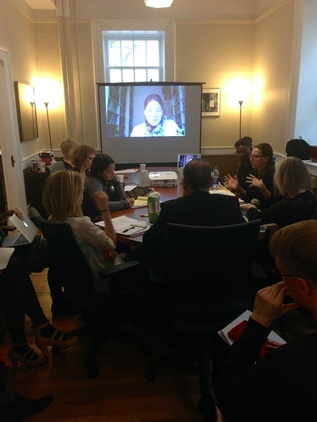
The conference began on the morning of the first day with participants discussing pre-circulated works-in-progress by two Illinois graduate students.  In “Computer Viruses and Infectious Agents: Transnational Memory in Hari Kunzru’s Transmission and Amitav Ghosh’s Calcutta Chromosome,” Jessica Young from English showed how viruses and other contagions can be deployed as literary metaphors of diasporic memory, and as literal vectors of diaspora since patterns of colonialism and imperialism have been determined, in part, by disease.  Hapsatou Wane from Comparative and World Literature presented “Wandering in the Womb of Memory: The Detour of the Surrogate Daughter in As Mulheres de Tijucopapo and Hérémakhonon, en attendant le bonheur.”  Responding to both students via Skype, Astrid Erll (Frankfurt) remarked that Wane’s paper showed how all cultural memory returns to points of entanglement rather than to unproblematic points of origin; and that Young’s work is innovative in its linkage of contagion with diasporic memory.  The two papers demonstrate, Erll noted, that literature very effectively charts “the geographies of memory.”   However, she affirmed the importance of encountering memory in various cultural materials and through diverse methods and disciplines, such as digital humanities and anthropology.    

In the afternoon, Michael Rothberg introduced two keynote speakers to a large public audience after explaining the impetus for the conference—to put in conversation multiple methodologies for studying diaspora and transnational memory, and to interrogate and compare categories such as settler colonialism, diasporic communities and indigenous peoples.  For the first keynote lecture, Aleida Assmann (Konstanz) presented “Transnational Memory and the Construction of History through Mass Media.”  Assmann observed that family serves as a vessel for memory but is also an impediment to the creation of national and transnational memory narratives that advance cross-cultural understanding, justice and peace.  Assmann illustrated this point effectively in her account of how the TV show Unsere Mütter, unsere Väter revealed some untold family secrets about WW II but did not succeed in helping the millions of Germans who watched the program imagine how other nationalities remember differently this shared past.  What the program lacked, Assmann seemed to be saying, is the kind of critical edge deployed by the students of the 1968 movement who challenged their parents’ version of what happened during the war and in the years immediately after.

For the second keynote lecture, Ann Rigney (Utrecht) presented “Diaspora Poetics and the Articulations of Memory,” in which she elaborated an essential poetics for representing diaspora.  Rigney argued that to speak from diaspora is to affirm a hyphenated identity; that memories of one’s dispersed family and community are filtered through the present time and place; and that identities and cultures are constantly remade by brutal forces like conquest, settlement, and assimilation.  All of these inform diaspora poetics.  Whether immigrants assimilate, or not, they change the places they come to, and they are changed by those new places.   Immigrants enter into new forms of entanglement, into new shared narratives that are not founded on kinship.  Rigney used these ideas to produce an innovative reading of Scott’s Ivanhoe and give an account of the novel’s reception in North America.  Ivanhoe is one model of how memory is made, how nations of diverse peoples must be imagined if they are to realize themselves historically, and how hybrid identities are forged.

The keynote lectures were followed by a lively roundtable discussion by four Illinois scholars in diverse disciplines.  Jodi A. Byrd stated that from the perspective of American Indian Studies, diaspora, as a description of a resettling, might not be a useful concept, especially because American Indians and other indigenous communities suffer from on-going colonial victimization.  Ronald Bailey suggested that African American Studies offers essential models for theorizing diaspora, especially with respect to the persistence of diasporic memory over longer time frames, even centuries. Historian Peter Fritzsche stressed that the national context still shapes the materials analyzed by both keynote speakers, suggesting that a transnational focus on cultural memory might mistake core issues.  In response to Fritzsche, Assmann agreed about the continuing centrality of the national but also argued that national and transnational memories co-evolve and cannot be studied in isolation.  Brett Ashley Kaplan, in Comparative Literature, described her in-progress comparative study of the works of W.G. Sebald and Gerhard Richter to illustrate how artists represent Nazi perpetrator memory as it travels across generations.

The second day of the conference began with remarks by two respondents, Matthew Nelson (Illinois) and me, Jonathan Druker (Illinois State), on some of the most salient ideas generated on the first day, and was followed by open discussion among all participants.  Nelson mused on forms of transnational memory, beyond prescriptive and descriptive versions of it, that take shape in the realm of the imaginative, which performs an important labor by giving affect and psychological depth to traces of history that cannot otherwise be made to speak.  In my remarks, I reflected on diasporic subjectivity, a condition in which one is multiply entangled in at least two spaces and two timeframes.     

The conference continued with participants discussing three more pre-circulated works-in-progress.  Tina M. Campt (Barnard) situated her paper, “Quiet Circuits of Memory: Passports, Photos and Diasporic Vernaculars,” in the context of an ongoing book project that asks “what kind of diasporic work … photographs do.”  Campt distinguished migration from diaspora, which she defined as a dwelling, a foundational moment when communities settle.  Rosanne Kennedy (Australian National) offered an overview of her paper, “In the Wake of Moby Dick: Whaling, Colonialism and (Trans)national Remembrance in Kim Scott’s That Deadman Dance,” which considers how a text like Moby Dick helped enable novelist Kim Scott to tell a story about traditional shore-based whaling among the Aboriginal people of Western Australia, and, at the same time, to link this local history to transnational memories of colonization.  Rebecca Saunders (Illinois State) offered “Mobilizing Memory: The Transnational Politics of Dememorialization in Roberto Bolaño’s Nocturno de Chile and the Films of Patricio Guzmán,” an account of how works of art nurtured beyond the borders of an oppressive regime can return home to dislodge spurious official histories.  Two Illinois colleagues, Yasemin Yildiz and Ellen Moodie, offered responses to the papers.

In the afternoon, Erica Lehrer (Concordia-Montreal) presented, “Curating Diasporic Memories,” which described an exhibit in Krakow she curated in the summer of 2013 that displayed, carved wooden figurines representing stereotypical Jews of pre-Holocaust Poland.  Through an innovative and dialogic design, Lehrer’s exhibit “Souvenir, Talisman, Toy” elicited complex responses from museum visitors, some of whom found the figurines to be antisemitic while others saw them as honoring the memory of Polish Jews or viewed them as merely nostalgic and kitschy.  These diverse responses suggest the persistence of contested and multi-layered memories of Jewish life and the Holocaust in Poland and beyond.  Respondent Jenelle Davis (Art History, Illinois) spoke about the challenges museums face when dealing with contested histories.   

Two pre-circulated works-in-progress were discussed in the last panel.  Sonali Thakkar (Chicago), in “Diaspora without Genealogy? Adoption, Zionism, and Queer Kinship,” addressed questions of identity, self-fashioning and post-memory that are raised by adoption.  Her work added thought-provoking complications to our assumptions about how familial bonds, which also act as constraints, shape memory.  Harriet Murav (Illinois), in “Memories of the Future: Freud, Bergson, and Bergelson,” brought together three authors that look for ways to think beyond the pathology of traumatic repetition, and to find, through memory, paths toward the future that are not completely determined by the past.  Respondent Pieter Vermeulen (Stockholm) said that both papers staged productive encounters between literature and theory to negotiate a return to the past that might, by unsettling received memory, open the way to more productive futures.

A concluding discussion was led by Ann Rigney, Aleida Assmann, and Michael Rothberg.  For Rigney, the conference affirmed a number of ideas, including the centrality of imagination in the creation and transformation of memory but also, pointing a way toward future research, in figuring futurity and hope.  Among many observations, Assmann commented on the productive tension that was uncovered between the mobility of memory and the idea that diasporic memory seems to issue from a settling or a new rooting.  Rothberg, touching on many aspects of the conference, suggested that the work presented affirmed the importance of the transnational as an analytical category that need not discount the national. 

0 Comments

Welcome to Days and Memory, the HGMS blog!

12/8/2013

0 Comments


We are pleased to welcome you to Days and Memory, the blog of the Initiative in Holocaust, Genocide, and Memory Studies (HGMS) at the University of Illinois at Urbana-Champaign. HGMS provides a platform for cutting-edge, comparative research, teaching, and public engagement related to genocide, trauma, and collective memory. We hope that this blog will serve as an opportunity to publicize and report on our local activities and to provide space for wide-ranging, open discussion of issues pertinent to genocide, trauma, and memory studies. The title of the blog is drawn from the brilliant Holocaust survivor and writer, Charlotte Delbo, whose book Days and Memory remains an innovative cornerstone of Holocaust literature.

While based in Illinois, HGMS is part of various international networks, including Mnemonics: Network for Memory Studies and NITMES: Network in Transnational Memory Studies. The discussions on our blog will thus speak to an international audience of scholars and practitioners. We are committed to a broad and comparative vision of the fields of genocide, trauma, and memory studies and this blog will engage with questions of violence and remembrance in transnational and transcultural terms.

We welcome the submission of short blog posts on relevant matters from any interested parties. We envision the blog as a site for book reviews, conference reports, manifestos, and provocations as well as reflections on urgent political matters and timely theoretical problems.

We hope you’ll visit us regularly, post comments, and join in the conversation! Please feel free to share the blog widely! 

0 Comments

    Illinois Jewish Studieswww.facebook.com/IllinoisJewishStudies/

    The Initiative in Holocaust, Genocide, and Memory Studies

    is an interdisciplinary program based at the University of Illinois at Urbana-Champaign. Founded in 2009 and located within the Program in Jewish Culture and Society, HGMS provides a platform for cutting-edge, comparative research, teaching, and public engagement related to genocide, trauma, and collective memory.    ​

    Archives

    November 2022
    May 2022
    March 2022
    November 2021
    March 2021
    February 2021
    November 2020
    June 2020
    May 2020
    February 2020
    July 2019
    October 2018
    May 2018
    April 2018
    November 2017
    October 2017
    August 2017
    April 2017
    March 2017
    December 2016
    December 2015
    March 2015
    January 2015
    December 2014
    October 2014
    September 2014
    June 2014
    April 2014
    March 2014
    February 2014
    December 2013

    Categories

    All

    RSS Feed

Powered by Create your own unique website with customizable templates.
  • Blog
  • About
  • Contact
